When Taglines Fail: How the HSF Riggersafe Push Pull Hand Safety Tool Prevented a Hand Injury During Windy Load Alignment
Background / Context
In oil & gas, marine, and construction lifting, rope taglines are widely used to control suspended loads and keep crews at a distance. They’re effective for long-range guiding and reducing swing — but they have limits:
Wind can suddenly overpower tagline control.
Close-in alignment (final 0.5–1.0 m before landing/fit-up) often demands precision, which taglines alone don’t provide.
In loss-of-control moments, riggers may instinctively reach for the load — putting hands in pinch/crush zones.
Why this matters: hand and finger injuries are among the most frequent recordable incidents in lifting operations, driving lost time, cost, and non-compliance.
Incident Scenario (Unsafe Practice)
Site conditions: structural steel lift; gusting wind; limited laydown space.
Control setup: one rope tagline; no close-control tool available.
Sequence of events (timeline):
Load picked and slewed toward set-down.
A gust pushes the load; tagline slips through the rigger’s gloved hand.
To arrest swing and “save” the landing, the rigger instinctively grabs the steel.
Contact with a sharp edge leads to a hand sprain and cut; operation paused; first aid administered.
One brief loss of control cascaded into avoidable downtime and cost.
Root Cause Analysis
Immediate cause: loss of tagline effectiveness in gusty wind → instinctive hands-on contact.
Underlying causes:
Control mismatch: tagline = distance control, not close-in alignment.
Tooling gap: no hands-free close-control device available at the set-down point.
Procedural gap: JSA didn’t define wind thresholds for adding a second control, or stop/pause criteria.
Human factors: time pressure; “save the lift” mindset; overreliance on one control (rope).
Training: insufficient emphasis on never substituting hands when control is lost.
Lesson Learned
Taglines guide from afar; they do not align up close.
When precision is needed (final positioning, dogging into place, navigating obstructions), crews require a rigid, hands-free interface that provides leverage without hand contact.
Establish wind/action thresholds: if gusts exceed X m/s or control degrades → add Push Pull Tool or pause.
HSF Solution (Safe Practice)
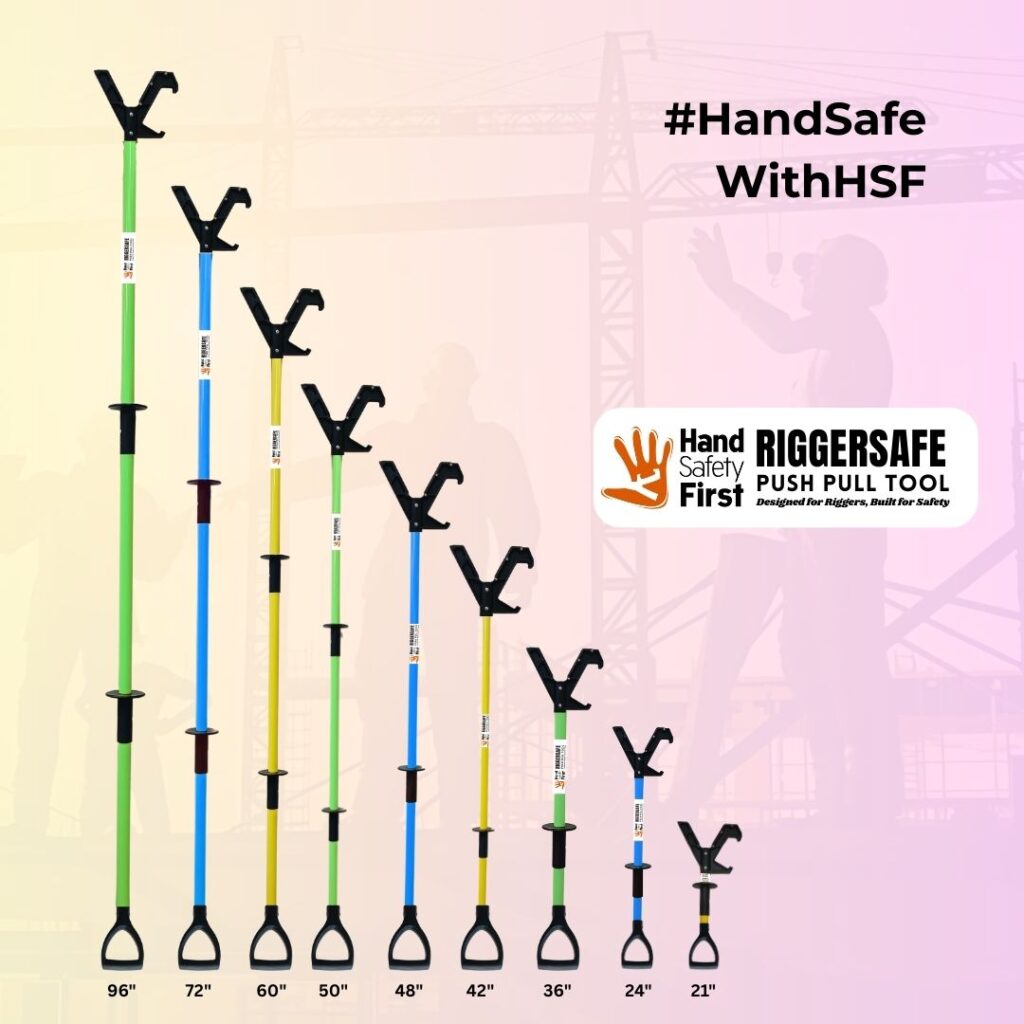
HSF Riggersafe Push Pull Hand Safety Tool closes the gap between rope and bare hands:
1.5 m safe distance keeps hands out of the line of fire.
Rigid control & leverage for close-in alignment (the last 0.5–1.0 m before landing).
Ergonomic grip and reinforced tip for positive contact on beams, frames, pipe spools, crates, and skids.
Predictable control in wind: unlike rope slip, a rigid stick resists sudden loss of tension.
Hands-free compliance: supports client and project hands-off policies.
How it integrates with taglines:
Use taglines for approach & swing control.
As the load enters the alignment zone, transition to one or two HSF Riggersafe Push Pull Hand Safety Tool for precise positioning and landing — no hands on load at any time.
Results (If Applied)
Across comparable lifts where HSF Riggersafe Push Pull Hand Safety Tool were introduced alongside taglines, sites reported:
Marked reduction in hand/finger contacts during load landing and fit-up.
Fewer pauses/re-sets in gusty conditions (more predictable final control).
Faster, cleaner landings with better crew confidence and communication.
Improved compliance posture during audits and client walk-downs.
(Pro tip: Track “hands near suspended load” observations before/after rollout to quantify improvement.)
Left (Rope only)
Right (HSF Stick)
gust → rope slips → rigger reaches → hand at risk (sprain/cut).
gust → controlled push/pull from 1.5 m → smooth alignment → zero hand contact.
Equip crews with the HSF Riggersafe Push Pull Hand Safety Tool to keep hands off loads — even when the wind picks up and precision matters.
#HandsSafeWithHSF
If you want to see how the HSF Riggersafe Push Pull Hand Safety Tool can improve your rigging operations,