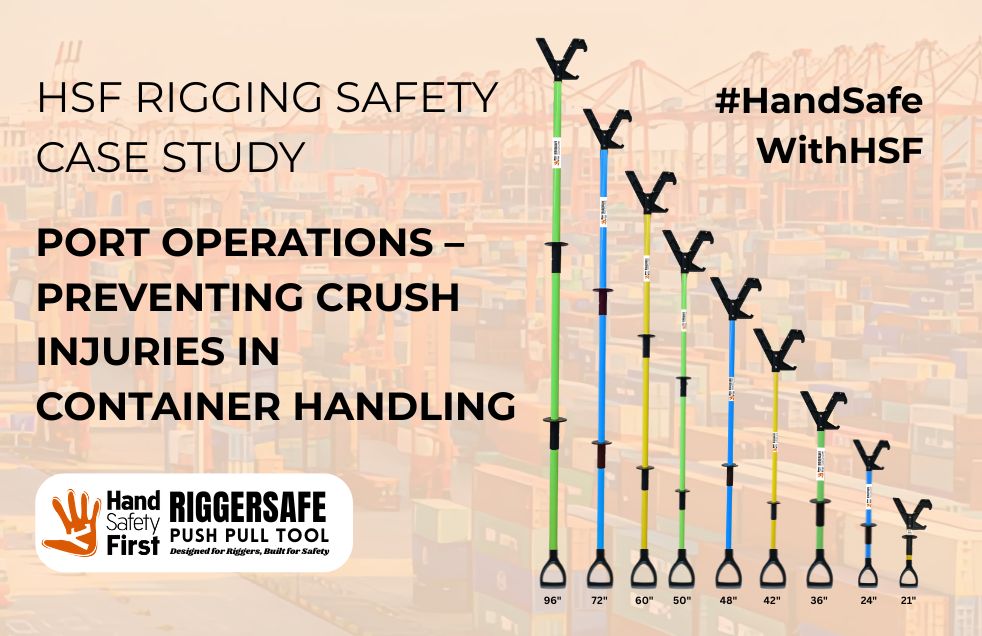
HSF RiggerSafe Push Pull Hand Safety Tool - Port Operations Preventing Crush Injuries in Container Handling
“Big Loads, Bigger Risks: How the HSF Riggersafe Push Pull Hand Safety Tool Prevented a Container Crush Injury”
Background / Context
Ports and container terminals operate at massive scale. Hundreds of containers are lifted, moved, and landed daily using cranes and spreaders. Safety systems are strong, but risk persists in the last few moments of container positioning.
Key risks in container handling:
Sheer weight & energy: A standard 20-ft container weighs up to 24 tonnes fully loaded. Even a 5 cm swing has huge force.
Pinch zones: Corner castings and deck frames create tight crush gaps.
Dynamic environment: Wind, swell (at marine ports), and uneven laydown areas add unpredictability.
Human instinct: Workers often feel compelled to “help” containers align by nudging with their hands.
Industry safety reports consistently rank container handling among the highest-risk activities for hand and finger injuries in maritime logistics.
Incident Scenario (Unsafe Practice)
During a routine container unloading operation:
Load: Standard container lifted from vessel toward yard.
Setup: Crane + single tagline for swing control.
Problem: As the container neared its set-down spot, it was slightly misaligned with the guiding frame.
Unsafe act: A worker stepped forward and attempted to manually nudge the suspended container into position using his bare hands.
Accident: Fingers became trapped between the container corner casting and the edge of the receiving frame.
Consequences / Impact
Injury: Severe crush injury, partial finger damage.
Lost Time: Over 20 days away from work (restricted duty + recovery).
Operational Impact:
Crane operations halted immediately.
Medical evacuation & emergency treatment.
Rescheduling of container offloading.
Cost Drivers:
Medical + compensation.
Crane downtime charges.
Overtime & backfill for lost worker.
Investigation, paperwork, and safety retraining.
Reputation:
Negative impact on client Key Performance Indicators (KPIs).
Authority-mandated corrective actions.
Root Cause Analysis
Immediate Cause: Worker placed hands directly on a suspended container.
Contributing Factors:
Control mismatch: Tagline was sufficient for broad swing control but not precise alignment.
Tool gap: No rigid, hands-free device available for close positioning.
Cultural factor: “Get it done quickly” mindset → instinct to push by hand.
Procedural gap: Job Safety Analysis (JSA) didn’t explicitly forbid hands-on contact during container landing.
Training: Crew lacked reinforcement of “no hands near suspended load” principle in container rigging.
Lesson Learned
Hands must never touch suspended containers — even for “small” nudges.
Taglines = distance control (broad guiding, reducing swing).
Rigid tools = close control (precise alignment, final positioning).
Safety depends on having the right tool for the right phase of the lift.
HSF Solution (Safe Practice)
The HSF Riggersafe Push Pull Hand Safety Tool provides the missing link in container handling safety.
Distance: Keeps workers at least 1.5 m away from suspended loads.
Rigid control: Provides leverage to push, pull, or hold containers steady for final positioning.
Precision: Effective in the critical last 0.5–1.0 m before set-down, where taglines lose accuracy.
Resilience in wind: Unlike ropes, rigid sticks do not slip suddenly.
Compliance: Supports “Hands-Off Load” policies mandated by global port and offshore operators.
Integration with taglines:
Use taglines for long-range guiding during container approach.
Transition to HSF Riggersafe Push Pull Hand Safety Tool for final alignment into frames or landing spots.
No need for hands-on contact at any stage.
Results (If Applied)
Where HSF Riggersafe Push Pull Hand Safety Tool were implemented in container yards and port operations:
Hand/finger contact during alignment dropped by >70%.
Reduced downtime from hand injuries and unsafe acts.
Smoother landings → less rework and faster cycle times.
Positive audit outcomes → clients recognized sites as compliant with international “Hands-Free” standards.
Crew confidence improved → less stress during container set-downs.
Unsafe Practice → Worker touching suspended container (red danger zone highlighted).
Caption: “One hand on a 24-tonne load = seconds away from disaster.”
Safe Practice → Worker using Push Pull Stick from 1.5 m distance.
Caption: “Big loads, bigger risks. Small tool, big protection.”
Side-by-side → Rope vs Stick control.
Rope = good for distance.
Stick = essential for close alignment.
“Big loads, bigger risks. Small tool, big protection.”
Stop container hand injuries before they happen.
Equip your port crews with the HSF Riggersafe Push Pull Hand Safety Tool.
#HandsSafeWithHSF
If you want to see how the HSF Riggersafe Push Pull Hand Safety Tool can improve your rigging operations,
Send us a Mail on info@handsafetyfirst.com
Visit us:
Website – riggersafe.com
Have An Enquiry For Us?

Fill The Form
Fill The Form

