
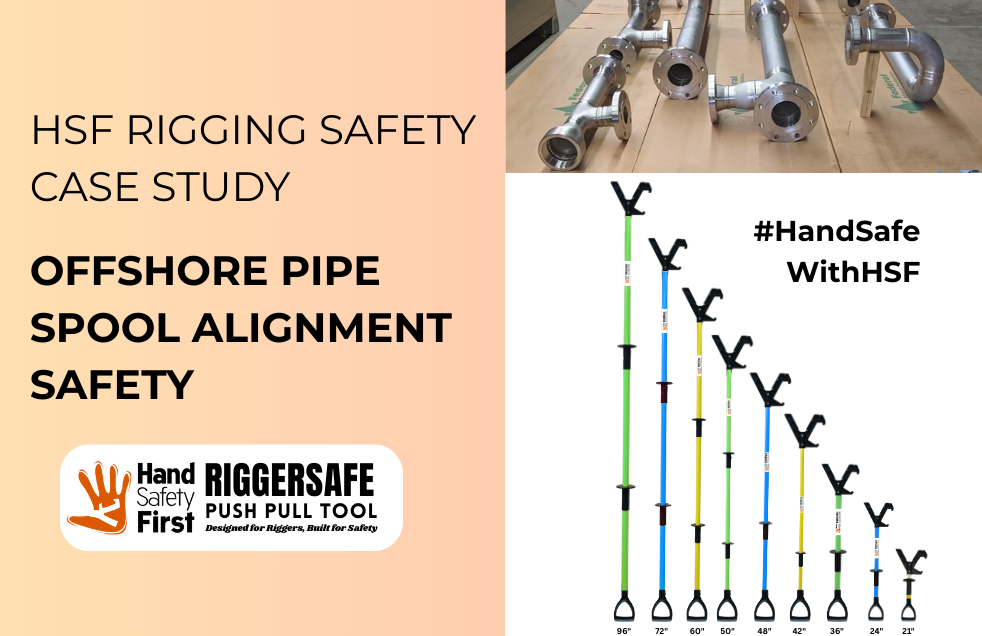
HSF Riggersafe Push Pull Hand Safety Tool - Offshore Pipe Spool Alignment Safety
Background
Offshore oil & gas projects require frequent lifting, transportation, and installation of pipe spools large, heavy, cylindrical sections of pipe that are pre-fabricated and connected during maintenance or new construction.
Handling these components on offshore platforms presents a unique set of challenges:
- Pipe spools can weigh several tons and are often unwieldy due to their round geometry.
- Swell, wave motion, and wind contribute to unpredictable load behavior.
- Crane sway or uneven lowering can cause sudden movements or rotation.
- Decks are slippery from seawater, oil residues, or weather, further complicating load control.
Riggers specialized workers responsible for safely moving and aligning loads are required to guide these pipe spools into position. In many cases, they use their hands to manually stabilize, align, or rotate the spool ends, despite the risks involved.
Why manual guidance is unsafe:
- Pipe spools are prone to roll, spin, or shift when landing or being maneuvered.
- Offshore environments increase load instability.
- Human reaction time cannot prevent sudden rollovers.
- Once a hand or finger is caught between the pipe edge and another surface, serious injury is inevitable.
Offshore environments account for some of the highest rates of lost-time injuries, and pipe-related accidents are among the leading causes.
Scenario (Incident Description)
During a routine offshore pipe installation operation, a crew of riggers was tasked with aligning a suspended pipe spool with existing support structures on the deck.
What happened:
- The spool was slowly lowered by crane.
- Crew members reached out to manually guide the spool’s rotation and ensure alignment.
- As the spool made contact with the deck, its round geometry and uneven weight distribution caused it to rotate unexpectedly.
- One worker, attempting to stabilize the spool by holding its edge, had his hand trapped between the pipe’s flange and the deck structure.
- The force of the rotation crushed his fingers, resulting in fractures and deep cuts requiring emergency medical intervention.
Contributing factors:
- Manual handling instead of using tools.
- Offshore environmental factors such as wind and wave action.
- Lack of protective procedure or equipment to mitigate load rotation.
- Overconfidence in controlling the load through strength alone.
Risks & Potential Injuries
Primary risks during pipe spool alignment:
- Pinch or crush injuries – fingers or hands trapped between the pipe edge and structures.
- Fractures – broken bones from sudden forceful load shifts.
- Lacerations – cuts and deep wounds caused by metal edges or jagged flanges.
- Strain injuries – muscles and ligaments stressed from trying to control or resist the spool’s movement.
- Secondary injuries – slips and falls while reacting to unexpected motion.
Impact of such injuries:
- Weeks or months of lost work time.
- Medical evacuations via helicopter in offshore emergencies.
- Costly downtime affecting project timelines and budgets.
- Legal liabilities and compensation claims.
- Lower morale and increased risk awareness among crews.
Lessons Learned
Core insights:
- The geometry of pipe spools makes manual control unreliable.
- Offshore motion magnifies risk by making load movements unpredictable.
- Human strength and reflexes cannot compensate for the forces involved.
- Injuries from rotating pipes are preventable with proper tools and procedures.
Key takeaway:
“Never attempt to manually align or rotate pipe spools. Cylindrical loads roll — and hands don’t stand a chance.”
Safety protocols must prioritize tool-assisted handling to prevent injuries before they occur.
HSF Solution (HSF Riggersafe Push Pull Hand Safety Tool)
The HSF Riggersafe Push Pull Hand Safety Tool is engineered specifically to address these hazards by allowing riggers to guide heavy pipe spools safely without entering pinch zones.
Design features:
Extended reach – Keeps workers at a safe distance from moving loads while still allowing precise control.
Non-slip, angled head – Maintains a firm grip against the spool surface, even in wet or oily conditions.
Durable construction – Lightweight fiberglass and non-conductive materials withstand offshore environments while reducing fatigue.
Ergonomic handle – Designed for ease of use over extended operations without strain or discomfort.
Operational benefits:
- Enables crew members to safely push, pull, and rotate pipe spools from a secure distance.
- Eliminates the need for direct hand contact with load edges.
- Provides leverage and stability during spool rotation.
- Facilitates quick and accurate alignment without guesswork.
Safety benefits:
Removes hands from pinch zones
Reduces injuries caused by sudden spool rotation
Minimizes exposure to offshore hazards
Enhances operational efficiency and confidence
Meets offshore safety regulations and best practices
Outcome / Results
After adopting the HSF Riggersafe Push Pull Hand Safety Tool, offshore crews reported significant improvements in safety and efficiency:
What changed:
- Manual guiding was replaced with tool-assisted alignment.
- Crew members no longer needed to risk placing hands near pipe edges.
- Even during unexpected rotation events, workers remained safe and injuries were avoided.
- Operations continued without disruption, avoiding evacuation or emergency intervention.
Quantifiable benefits:
- Zero pinch or crush injuries since implementation.
- Reduced downtime due to fewer incidents and quicker alignment.
- Improved morale as crews felt safer handling heavy loads.
- Enhanced compliance with industry safety standards and offshore protocols.
What could have happened without the tool:
- Even a slight rotation could have caused multiple injuries.
- Offshore medical evacuation might have been required.
- The project could have faced delays and additional costs from lost-time injuries.
“Pipe rolls. Stick controls.”
Protect your crew, boost operational safety, and avoid unnecessary downtime with the HSF Riggersafe Push Pull Hand Safety Tool.
HSF.
Keep riggers out of the line-of-fire during offshore pipe handling and alignment.
Contact us today to learn how the HSF Riggersafe Push Pull Hand Safety Tool can safeguard your team and streamline pipe alignment operations offshore.
#HandsSafeWithHSF
If you want to see how the HSF Riggersafe Push Pull Hand Safety Tool can improve your rigging operations,
Send us a Mail on info@handsafetyfirst.com
Visit us:
riggersafe.com
Have An Enquiry For Us?

Fill The Form
Fill The Form

