RiggerSafe®
Hand Exposure Control Series · Publication 2
Behavioural Analysis · Suspended Load Hazards
The Hand Moves Before the Mind
Why Experienced Riggers Still Reach for Suspended Loads
An experienced rigger reaching toward a suspended load is rarely acting carelessly. The movement begins as a rapid response to something he has seen — a slight rotation, a narrowing clearance, a load beginning to drift. Understanding that impulse is the first step to redirecting it.
The load moves less than an inch.
The rigger sees it before anyone else.
A corner begins drifting away from the landing point. The movement is slow, familiar and apparently harmless. There is no alarm. No one calls for the lift to stop.
The rigger's hand rises.
Not because he has ignored his training. Not because he has forgotten the hazards. His hand moves because it has corrected movements like this for years.
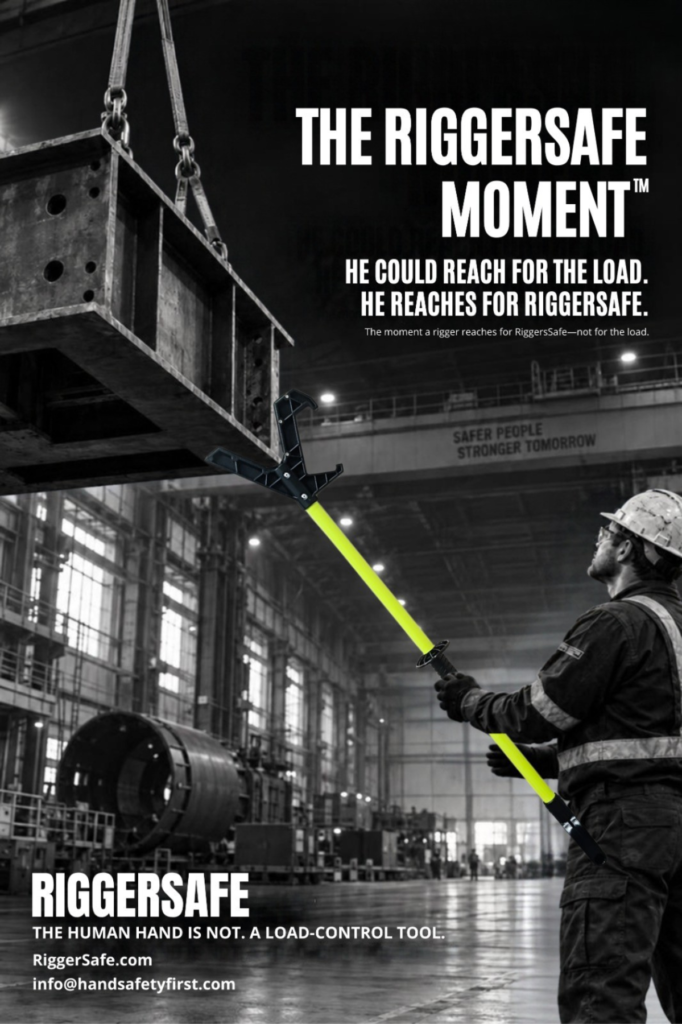
This time, RiggerSafe® is already within reach. The hand changes direction. The movement took less than a second. The preparation began before lift-off.
That is the RiggerSafe Moment™.
INDUSTRIAL HAND SAFETY
RiggerSafe® push-pull tools are engineered to replace the hand as a load-control tool.
This publication is produced by PSC Hand Safety India for the global industrial lifting community.
RiggerSafe®
The Hand Moves Before the Mind
2
The Hand Moves Before the Mind
When an experienced rigger reaches toward a suspended load, it is easy to describe the action as carelessness. That explanation is convenient. It is also incomplete.
Experienced workers do not normally approach a load intending to place their hands in a pinch, crush or caught-between exposure. The movement is often a rapid response to something they have seen: a slight rotation, a narrowing clearance, an imperfect alignment, a load beginning to drift.
The hand responds because it has responded before. What looks like a deliberate unsafe act may begin as an instinctive attempt to restore control. If industry wants to change that behaviour, it must understand why the hand moves — not merely instruct it to remain still.
Experience can improve judgement. It can also make familiar exposure feel normal.
Experience can improve judgement. It can also make familiar exposure feel normal.
The RiggerSafe Moment™ is the instant a rigger feels the impulse to reach toward a suspended load — and instead uses the planned appropriate tool.
This definition matters because it places the intervention at the behavioural decision point. The RiggerSafe Moment does not begin after the hand touches the load. It begins when the worker first perceives the need to intervene.
The objective is not to slow the rigger's response. It is to change what the rigger instinctively reaches for.
The Intelligence of the Hand
The human hand is extraordinarily capable. It can estimate position, detect vibration, feel resistance and make small corrections without lengthy conscious calculation. A cup begins to tip — the hand catches it. A door starts closing — the hand holds it. These responses are useful precisely because they are fast.
But a suspended industrial load is not an ordinary object. Its mass, momentum, centre of gravity and connection to lifting equipment can create movement that the hand cannot safely resist or predict. A slow-moving load can still close a gap. A small rotation can bring a hand between steel and structure.
The problem is not that the hand lacks intelligence. The problem is that the hand is being asked to perform a task for which it provides no engineered separation.
RiggerSafe®
Why the Reflex Becomes Stronger With Experience
3
Why the Reflex Becomes Stronger With Experience
New workers may hesitate because the task is unfamiliar. Experienced workers often act quickly because they recognise what is happening.
They have seen a beam begin to rotate. They know how a pipe spool normally settles. They can anticipate how a cargo basket will respond near the deck. They recognise when a component is approaching its landing point at the wrong angle.
That knowledge is valuable. But repeated successful direct contact can also change the perception of risk. If a worker has touched suspended loads hundreds of times without an incident, the action may no longer feel exceptional. It becomes part of the task.
I have done this before.
The load is barely moving.
I will touch it only for a second.
I need to make one small correction.
My hand will be gone before the gap closes.
Stopping the lift will take longer than adjusting it.
This is not necessarily a failure to understand the hazard. It can be a gradual normalisation of exposure. Nothing adverse happened during the previous contact, so the contact begins to feel controlled. But the absence of an incident does not prove that the method was safe. It may only mean that the load behaved as expected on those occasions. The next movement may be different.
Five Forces That Make the Hand Move
1
Muscle Memory
Repeated actions become easier and faster because the body learns their sequence. If a rigger has always used a hand to steady the final movement, that response may begin before the conscious mind has reviewed the exposure. The tool must be familiar, selected correctly, and positioned before it is needed — otherwise the hand remains the fastest available option.
2
Familiarity
A known task often feels safer than an unfamiliar one. Familiarity can improve planning, but it can also reduce attention to the point where direct contact usually occurs. The question should not only be "Have we done this lift before?" It should also be: "Where did the hand enter the last time?"
3
Urgency
The load is nearly in position. Production is waiting. A minor misalignment appears to require only a quick correction. Stopping can feel disproportionate to the movement being observed. Yet urgency changes neither the weight of the load nor the geometry of the closing space. The correct response must be agreed upon before urgency arrives.
4
Perceived Precision
Hands are associated with fine control. During final positioning, workers may believe that only direct touch can provide the required accuracy. But precision does not justify placing the hand in a hazardous interface. If the required precision cannot be achieved through the planned method, the answer is to stop and revise the plan.
5
Absence of a Ready Alternative
"Keep your hands clear" is difficult to apply when the work still requires someone to influence the load and no suitable method has been prepared. The alternative must not merely exist somewhere on the site. It must be selected, inspected and positioned for the specific lift. A safer reflex cannot develop if the safer option is not within reach.
RiggerSafe®
Do Not Blame the Hand · Find the Hand™
4
Do Not Blame the Hand. Redesign the Response.
Behavioural change fails when it begins and ends with correction. A supervisor sees a worker touch a suspended load and says, "Keep your hands off." The worker withdraws the hand. But if the task still requires alignment, orientation or controlled movement, the underlying need remains.
A stronger response asks:
- What movement was the worker trying to control?
- Why did direct contact appear necessary?
- Was that hand-entry point identified during planning?
- Was the selected control appropriate?
- Was the tool positioned before the lift?
- Did the worker have a clear escape route and agreed stop conditions?
- Does the task need to be redesigned?
This approach does not excuse direct contact. It makes the prevention more effective by addressing the reason it occurred.
A safer reflex cannot develop if the safer option is not within reach.
Find the Hand™ is a practical method for locating the exposure before the task begins. The team studies the lift and asks where a worker is most likely to feel the need to touch the load.
Behavioural Pressure Points
- Load first becoming free from its support
- Elongated load beginning to rotate
- Component approaching a restricted area
- Corner drifting toward an obstruction
- Final orientation before landing
- Alignment with foundations or supports
- A closing gap during final placement
- The temptation to steady before release
Questions for Each Pressure Point
- Where will the rigger stand?
- What will the rigger use?
- What movement is the control intended to influence?
- What must remain outside the exclusion zone?
- When must the lift stop?
A suspended load may travel across an entire workshop without direct hand contact. Then it approaches the destination. The clearance narrows. Alignment becomes important. The rigger moves closer. The hand returns.
The Last 300 mm Rule™ is an observation lens for examining this final approach — not a statutory distance, but a focus on the point where the perceived need for precision becomes strongest. The journey may be controlled. The final positioning may still create the RiggerSafe Moment. The team should therefore examine not only how the load will travel, but how it will finish.
RiggerSafe®
Replacing Reflex With Readiness · Industry Applications
5
Replacing Reflex With Readiness
Telling a worker to suppress an automatic response is less reliable than giving the response a safer destination. The objective is to create a new sequence: the load changes orientation; the rigger recognises the moment; the hand reaches for the planned tool; the worker remains in the planned position.
If conditions remain within the lift plan, the controlled adjustment continues. If the movement becomes unpredictable or departs from the plan, the lift stops. This sequence must be practised until it feels natural.
What Integration Requires
- Application-specific tool selection
- Inspection before use
- Clear storage and accessibility
- Practical task-based training
- Defined worker positions
Reinforcement at Every Level
- Agreed communications
- Rehearsed stop conditions
- Supervisor reinforcement
- Post-lift learning
The RiggerSafe Moment Across Heavy Industry
Structural Steel
Old reflex: an open hand against the flange as the beam rotates.
New response: planned control used from outside the identified exposure — or lift stopped if movement exceeds the plan.
Offshore Lifting
Old reflex: step closer and steady the corner as the basket's orientation shifts.
New response: suitable controls, clear deck positions, communication, escape routes and agreed stop conditions — planned before the basket descends.
Transformer Positioning
Old reflex: use hands for fine correction during final foundation alignment.
New response: plan the final positioning method around the required precision using appropriate controls — no hands in closing gaps.
Pipe-Spool Handling
Old reflex: grab the pipe or flange to correct the wrong orientation.
New response: pre-planned method only while load remains controlled — stop when conditions differ from the plan.
Fabrication & Maintenance
Old reflex: guide by hand because the distance appears small.
New response: recognise that small distance means reduced reaction time and greater caught-between exposure.
The Toolbox Talk Question
"Where is the RiggerSafe Moment in this lift?"
Ask where someone will want to touch the load. Ask what control has been selected and where it will be positioned. This gives the crew a shared picture before the decision occurs.
RiggerSafe®
Responsible Boundaries · Closing Manifesto
6
Responsible Safety Boundaries
RiggerSafe is not an emergency device for recovering an uncontrolled load. A push-pull tool must not be used as justification for standing beneath a suspended load, entering a closing gap or continuing after control has been lost.
RiggerSafe Does Not Replace
- A competent lift plan
- Correct rigging and inspection
- Crane control
- Clear communications
- Exclusion zones
- Taglines where appropriate
- Safe positioning and escape routes
When the Correct Action is to Stop
- Movement becomes unstable
- Visibility is lost
- Communications fail
- Conditions differ materially from the lift plan
- Control has been lost
The safest hand is sometimes the hand giving the stop signal.
From Inherited Instinct to Industrial Habit
The hand moves because it is experienced.
It moves because it recognises the problem. It moves because it wants to restore alignment, protect the equipment and complete the job.
Do not dismiss that instinct. Plan for it.
Find where the hand will want to enter. Understand what it will try to achieve. Choose the appropriate control. Put it in position before the lift begins. Define the point at which the lift must stop.
Then build a new reflex.
When the load turns, do not reach toward it. When the clearance narrows, do not let familiarity decide. When precision is required, do not ask the hand to become the tool.
Let experience make a better choice.
Because the human hand is not a load-control tool.
Do not blame the hand. Understand what it was trying to achieve — and redesign the response.