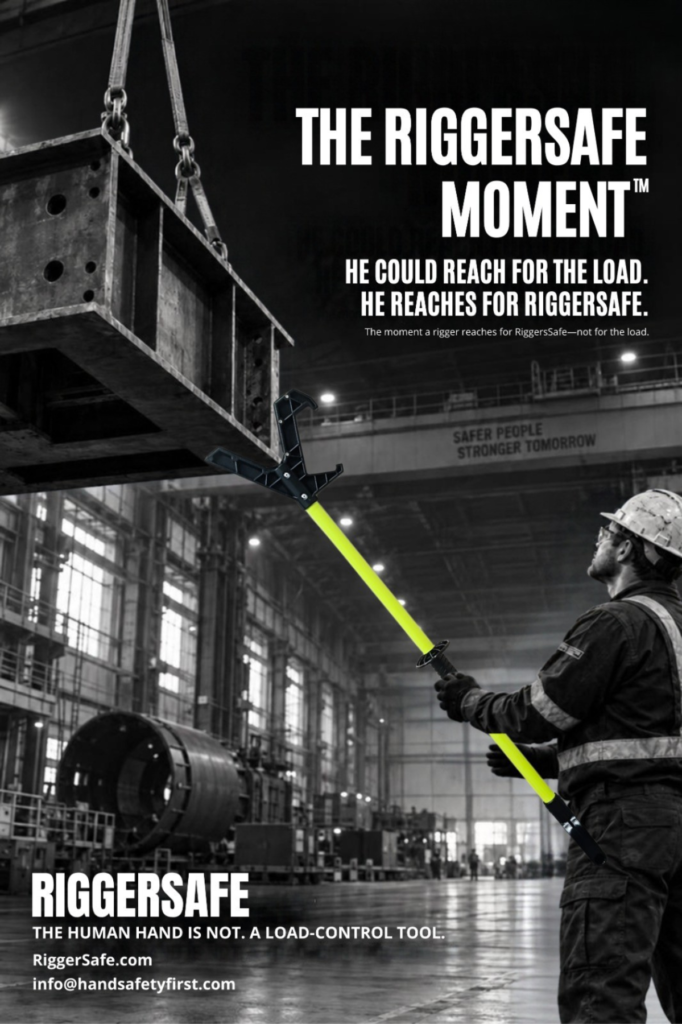
EVERY SUSPENDED
LOAD HAS
A MOMENT.
The instant a rigger feels the impulse to reach toward a suspended load — and what happens next — is the most consequential fraction of a second in any lift.
The load is now less than half a metre from its final position.
It turns slightly.
Not violently. Not enough to stop the lift. Just enough to disturb the alignment.
A rigger watches the edge move away from its mark. His body responds before anyone says a word. His shoulder turns. His arm begins to rise. His hand starts moving toward the steel.
For a fraction of a second, everything depends on what happens next.
The hand can continue toward the suspended load.
Or it can reach for the tool already positioned beside the rigger.
He chooses RiggerSafe®.
That choice has a name.
The load moved. A hand entered. A clearance closed. A worker was caught between two surfaces. An ordinary lifting activity became an investigation.
But before the contact, before the near miss and before the incident, there was usually a smaller event.
There was a decision.
Sometimes it lasted several seconds. Often, it lasted less than one.
A load began to rotate. A steel beam moved away from its landing point. An offshore basket drifted. A pipe spool needed a final adjustment. A transformer approached its foundation slightly out of alignment.
The rigger saw the movement and felt the need to respond.
That is the moment industrial safety must learn to recognise.
Not merely the hazard. Not merely the suspended load. Not merely the pinch point.
The moment when the hand instinctively wants to become the tool.
The RiggerSafe Moment is not a claim that one tool makes every lifting situation safe. It is a way of identifying a specific behavioural decision within a properly planned and controlled lift.
It gives the decision a name.
And when a decision has a name, a team can discuss it, plan for it, observe it and improve it.
ALWAYS BEEN
AVAILABLE.
It can detect small movements, judge surfaces, feel resistance and make fine corrections. It is always present, immediately available and guided by years of experience.
That is precisely why it so easily enters hazardous work.
When a suspended load needs a minor correction, the hand often appears to offer the quickest answer. The rigger may have touched similar loads hundreds of times. The movement may look slow. The correction may appear small. The contact may last only a second.
Familiarity can make the action feel controlled.
But the hand has no engineered stand-off distance. It cannot prevent a closing gap. It cannot resist several tonnes of momentum. It offers no protection when the load moves differently from what the worker expected.
IS NOT A
LOAD-CONTROL
TOOL.
This is not a criticism of riggers. It is a recognition of how work evolved.
For generations, hands were used because hands were available. Practices were repeated, passed from one crew to another and gradually accepted as normal.
The RiggerSafe Moment begins by challenging that normality.
A visibly unstable load will usually attract attention. A severe swing, damaged sling, unexpected crane movement or loss of communication should stop the operation.
The quieter exposure is different.
The lift appears controlled. The load is moving slowly. The destination is close. The rigger believes that one touch will complete the job.
This is where the hand can enter almost without conscious discussion.
Consider the final positioning of a structural beam. It has travelled safely across the work area. As it approaches its supports, one end remains slightly out of line. The rigger wants to guide the flange into position.
Or consider an offshore cargo basket approaching the deck. Wind, vessel movement or crane motion produces a small change in orientation. Someone steps closer, ready to steady it.
A transformer approaches its prepared foundation. The landing points are visible, but the final alignment needs adjustment.
A pipe spool is correctly suspended, yet its orientation must change before it can be placed.
In each case, the most consequential part of the task may not be the long journey through open space. It may be the final approach — when the destination is close and the hand returns.
PSC describes this observation through the Last 300 mm Rule™.
It is not presented as a universal legal distance or a substitute for site-specific risk assessment. It is a practical lens: look closely at the final positioning space, because this is often where workers feel the greatest need for direct contact.
The RiggerSafe Moment frequently lives inside that space.
In most crane-assisted load operations, the physical function is remarkably specific.
Each of these functions is different. Each may place the worker's body in a different physical relationship with the load. Each may create a different exposure. And each may occur within the Last 300 mm — in the final moments of an otherwise controlled lift.
It should also ask a more human question:
Where will someone feel the need to use a hand?
That is the purpose of Find the Hand™.
Find the Hand does not begin with the worker's behaviour after the lift starts. It begins by examining the task before lift-off.
The team looks for the places where direct contact may feel useful:
For every such point, the team asks: What movement are we expecting? What could change? Where is the pinch, crush or caught-between exposure? Can the movement be controlled through the lift method? Is a tagline appropriate? Is a suitable push-pull tool appropriate? Where should the rigger stand? What is the escape path? Under what conditions must the lift stop?
The objective is not to make the rigger decide between hand and tool after the load has become difficult to control.
The objective is to identify the RiggerSafe Moment in advance and ensure the correct control is already available.
NOT AN EMERGENCY RESPONSE TO A MOVING LOAD.
This time, during the pre-lift discussion, the team identifies that the beam may rotate as it approaches the supports. The final alignment is marked as a likely hand-entry point.
The team decides how the movement will be controlled. The correct RiggerSafe tool is selected for the planned task. Its condition is checked. The rigger's position and escape route are established. Communication and stop-work conditions are confirmed.
Before the crane takes the weight, the tool is placed where it can be reached without entering the load's path.
The beam rises. It travels. It approaches its landing point. One end begins to turn.
The instinct to reach still exists. Planning does not remove human instinct.
But it changes what happens next.
The rigger reaches for RiggerSafe.
The moment is no longer an improvised reaction. It is a planned response.
That is the transformation.
A push-pull tool does not make it acceptable to stand beneath a suspended load or remain in a closing gap. It does not justify continuing a lift when the load becomes unstable, the tool is unsuitable, visibility is lost, communication fails or conditions depart from the plan.
RiggerSafe does not replace:
Sometimes the correct RiggerSafe Moment is not reaching for any tool.
It is giving the stop signal.
The phrase is valuable only when it supports disciplined planning and competent judgement.
Begin with the hand. Ask the crew to look at the entire task and identify the point where someone will most likely feel the need to touch the load.
This conversation can take minutes.
Its effect occurs in a fraction of a second.
When the real moment arrives, the team has already decided what should happen.
It is to create a new reflex.
Today, when a suspended load requires a small correction, the inherited response may be to reach toward it.
The new response should be to pause and recognise the moment.
The rigger should see the narrowing clearance, the changing orientation or the final alignment and know that the hand is about to become the tool.
The lift team should already have addressed that moment.
The appropriate control should already be in position.
The worker should not have to improvise.
This is how a safety idea becomes a work practice: not through a slogan alone, but through repeated recognition, planning and action.
CHANCE.
REACH FOR RIGGERSAFE — NOT FOR THE LOAD.