Find the Hand
Before Lift-Off
A conventional lift plan is concerned with the load. But a lift can be mechanically well planned and still leave a behavioural gap — the moment when someone says, "Just hold that corner."
Find the Hand™ closes that gap before the crane takes the weight.
The load is still on the ground. The crane is silent. The slings have been laid out. The team has reviewed the weight, lifting points, travel path and signals. Nothing is moving.
Yet this may be the best opportunity the team will have to prevent direct hand exposure.
"Where will someone want to put a hand?"
The question changes the conversation. A rigger points to the leading corner. Another identifies the flange that will need final alignment. Someone notices that the planned tagline may be less useful during the last approach.
They can now see the hand before it appears. Only then does the crane take the weight.
The Gap a Lift Plan May Miss
A conventional lift plan is necessarily concerned with the load: what does it weigh, where is its centre of gravity, which lifting points, what rigging, what route, where does it land?
These are fundamental questions. But they do not always reveal the exact moment when a worker will feel the need to touch the load.
A lift can be mechanically well planned and still leave a behavioural gap. The crane can be suitable. The slings can be inspected. The travel path can be clear. Communications can be agreed.
Then the load approaches its final position and someone says: "Just hold that corner."
That sentence reveals what the plan may have missed. The lift was planned around the load, but not around the hand.
"If the lift plan cannot show where the hand enters, it has not yet found the exposure."
Find the Hand™ addresses that gap. It is a practical way to examine a task before lift-off and identify where direct hand contact is most likely to enter.
Find the Hand™ is a pre-task observation method used to identify where, when and why a worker may feel the need to place a hand near a suspended load.
The method does not begin by asking whether the worker knows the rules. It begins by asking what the task will demand.
Where will the load rotate? Where will clearances narrow? Where will accurate alignment become necessary? Where will a hand appear to offer the fastest solution?
Once those points are visible, the team can remove the need, redesign the method, select an appropriate control or establish a clear stop condition.
A drawing shows the equipment. A method statement describes the lift. A JSA or JHA lists suspended loads, line-of-fire hazards, pinch points and dropped-object exposure.
But the document may not show the worker's instinctive movement during the task. A rigger may step toward the load because it begins rotating. A banksman may reach for a corner because the landing point is close.
These actions are often treated as individual behavioural failures after they occur. Find the Hand asks a different question: could we have predicted that movement before the lift began?
In many cases, the answer is yes.
Start at the End of the Lift
One of the most useful ways to review a lifting task is to begin at the destination. The long travel path may be open and well controlled. The greater hand exposure may appear only when the load reaches the final positioning area.
Stand at the landing point and imagine the load approaching. Look at: the final orientation required, position of supports and obstructions, available working space, potential closing gaps, changes in visibility, the accuracy required, the worker's likely standing position, and the route available for withdrawal.
Then ask: when the load reaches this point, what will someone want to correct by hand?
This is where the Last 300 mm Rule™ becomes useful. It is not a statutory distance or a universal safe boundary. It is an observation principle: examine the final approach closely because this is where hands often return.
The load may travel metres without contact. The final positioning may create the strongest temptation to reach.
"Do not review only how the load will travel. Examine how it will finish."
Seven Stages of Find the Hand™
Observe the complete task
Watch or rehearse the entire activity from preparation through landing and release — rigging, lift-off, travel, rotation, approach, landing, de-tensioning. The RiggerSafe Moment may occur at more than one stage.
Identify the desired hand action
Define what the hand will be trying to accomplish: stop rotation, push a corner, pull toward alignment, hold orientation, align a flange, prevent contact with nearby equipment. Different actions require different controls.
Mark the exposure geometry
Where will the hand be relative to the load and structure? Hand between load and support, fingers around an edge, arm entering an area with no clear withdrawal path. Consider where the load could move, not only where it is expected to.
Identify what triggers the reach
Unexpected rotation, minor drift, misalignment, narrowing clearance, slow crane response, pressure to complete the lift. Naming the trigger helps the team plan the response.
Seven Stages — continued
Select the appropriate control
The hierarchy begins by asking whether the exposure can be removed through task design. Can orientation change before lifting? Can rigging reduce rotation? Can the landing arrangement guide the load mechanically? Where controlled pushing or pulling from a separated position is required, assess whether RiggerSafe is appropriate for the specific load, movement, reach and environment. One tool is not suitable for every suspended load.
Position the control before lift-off
A tool stored elsewhere is not yet a control. It must be selected for the application, inspected before use, available at the working position, and accessible without approaching the suspended load. The objective is not to begin searching for RiggerSafe after the hand feels the need to intervene.
Define the stopping point
Not every movement should be corrected. The lift plan must state when the operation stops: load moving outside the expected path, rotation exceeding planned control, loss of communication, reduced visibility, the selected tool proving unsuitable, or any person entering the exclusion zone. Competence lies in knowing the difference between using the planned tool and giving the stop signal.
"A tool stored elsewhere is not yet a control."
Three Concepts in Sequence
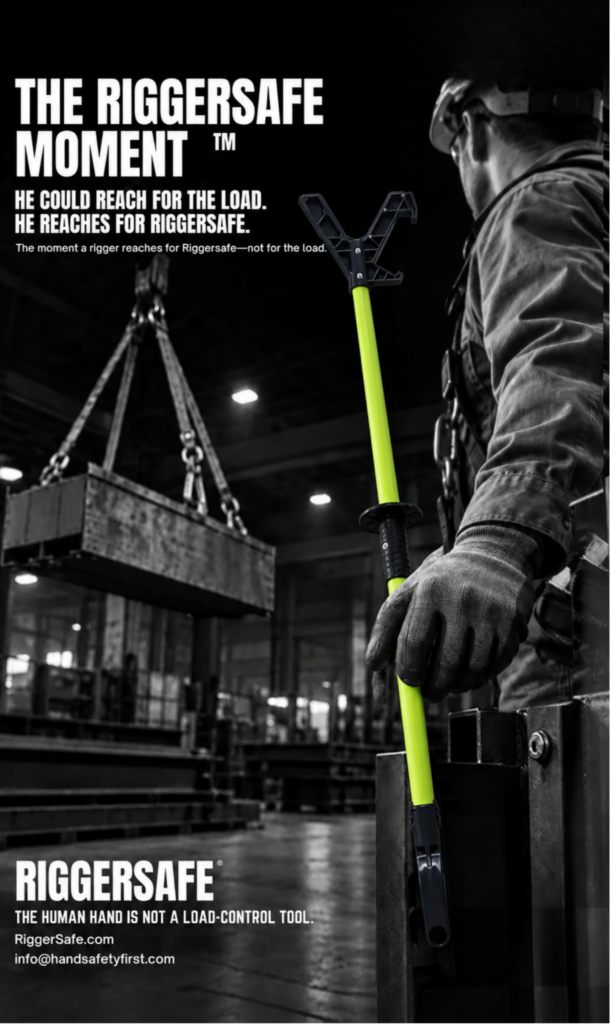
Find the Hand™ identifies the exposure. The Last 300 mm Rule™ focuses attention on final positioning where the exposure often becomes strongest. The RiggerSafe Moment™ names the behavioural decision when the worker feels the impulse to reach.
Find the Hand™
Identify where direct contact is likely to enter before the lift begins.
Last 300 mm Rule™
Study the approach, alignment, landing and closing clearances where hands most often return.
RiggerSafe Moment™
Plan what the worker reaches for instead — and when the lift must stop.
RiggerSafe is therefore not introduced as an afterthought. It becomes one potential planned control within a disciplined lifting method.
The Pre-Lift Questions That Reveal the Hand
A Find the Hand discussion should be specific enough for the crew to picture the task. These questions transform "hands clear" from a general instruction into a visible operating plan.
- When is the load most likely to rotate?
- Where could it drift?
- Will its orientation need to change?
- What movement is expected during initial lift-off?
- What movement is expected during final positioning?
- Could the load behave differently as rigging tension changes?
- At what point will someone feel tempted to touch the load?
- What will that hand be trying to achieve?
- Where would the hand be placed?
- What fixed surface could create a closing gap?
- Would the worker have a clear withdrawal route?
- Has the same task previously involved direct hand contact?
- What movement remains within the plan?
- What movement requires an immediate stop?
- Who can call the stop?
- How will that signal be communicated?
- What changes require the task to be reassessed?
- Can the need for manual guidance be eliminated?
- Can the rigging arrangement reduce the expected movement?
- Is a tagline appropriate for the task?
- Is a push-pull tool suitable for the intended movement?
- Has the correct tool length and configuration been selected?
- Has it been inspected?
- Where will it be positioned before lift-off?
- Who will use it?
"A stronger toolbox instruction gives the team a shared picture — the likely trigger, the likely hand movement, the selected control, the worker's position, the escape route, the stopping condition."
A weak toolbox instruction: "Keep your hands away from the load."
A stronger discussion names the corner, the planned control, the rigger's position, the escape route, and the rotation that requires a stop. That is the practical value of Find the Hand.
Find the Hand Across Heavy Industry
The method applies wherever a suspended load requires final positioning near a structure, a surface or another person. Six examples illustrate how the exposure differs by task — and why a single control cannot address every situation.
Structural-Steel Beam
The beam must land between supports. The open travel path is straightforward, but the leading end may rotate during approach. Find the Hand identifies the likely contact point at the flange. The team reviews rigging, rotation control, worker position and final alignment. If RiggerSafe is suitable, it is staged before lift-off. If rotation exceeds planned movement, the lift stops.
Offshore Cargo Basket
The basket approaches a deck affected by environmental movement. A worker may instinctively grab a corner to steady it. Find the Hand identifies the corner and the point where the worker could become positioned between the basket and surrounding structure. Deck control, communication, exclusion zones and stop conditions take priority. RiggerSafe does not make an unstable basket safe to engage.
Transformer Installation
The transformer must approach foundation points accurately. The temptation to use hands increases as clearances narrow. Find the Hand identifies the alignment points and potential closing gaps. The final positioning method should be engineered around the required precision rather than leaving the last correction to an exposed hand.
Pipe Spool
The spool must rotate to match its connection orientation. A worker may want to grab the pipe or flange. Find the Hand identifies the intended turning action. The team determines how rotation will be controlled, whether RiggerSafe is suitable, where the worker will stand, and when misalignment requires the lift to stop.
Maintenance Lift
A machine component is removed from a confined area. The load is relatively small but access is restricted. Find the Hand reveals that the worker may use one hand to protect nearby equipment while guiding the load with the other. The task should be redesigned so that the worker does not become the buffer between suspended equipment and fixed structure.
The Invisible Gap
In every example above, the hand is not physically present in the danger zone before the lift begins — which makes it easy to overlook. The JSA lists pinch points and dropped-object exposure. But the document may not show the worker's instinctive movement during the task. Find the Hand makes that movement visible while the load is still on the ground.
Responsible Safety Boundaries
Find the Hand is a planning and observation method. It does not certify that a lift is safe.
RiggerSafe does not replace competent lift planning, correctly selected and inspected rigging, appropriate crane operation, clear communications, exclusion zones, taglines where appropriate, engineered positioning systems, defined worker positions, escape routes, supervision, site procedures or stop-work authority.
A push-pull tool must not be used to engage an uncontrolled load, justify entry beneath a suspended load or permit a worker to remain inside a closing gap.
If the load becomes unstable, visibility is lost, communications fail or conditions differ from the plan — stop the lift and reassess.
"Keep your hands away from the load."
"The leading end may rotate as the beam enters the supports. That is where someone may want to use a hand. The planned control is positioned here. The rigger remains here, with this escape route. If the rotation exceeds this controlled movement, we stop."
Closing
Do not wait for the hand to appear.
Find it while the load is still on the ground. Find it in the rotation no one has discussed. Find it at the corner approaching the column. Find it in the flange that must align. Find it in the final approach where the clearance disappears. Find it in the familiar task everyone believes they understand.
Then ask what that hand will be trying to do.
Remove the need where possible. Engineer the movement. Select the appropriate control. Position it before lift-off. Define when the work must stop.
The hand should not have to improvise beside a suspended load. Because the human hand is not a load-control tool. And because the safest time to change a decision is before the moment arrives.
Find the moment before the lift. Reach for RiggerSafe — not for the load.