Reactor Lift Pinch Point Hazards: Preventing Hand Injuries During Load Positioning
Reactor Lift Pinch Point Hazards: Preventing Hand Injuries During Load Positioning
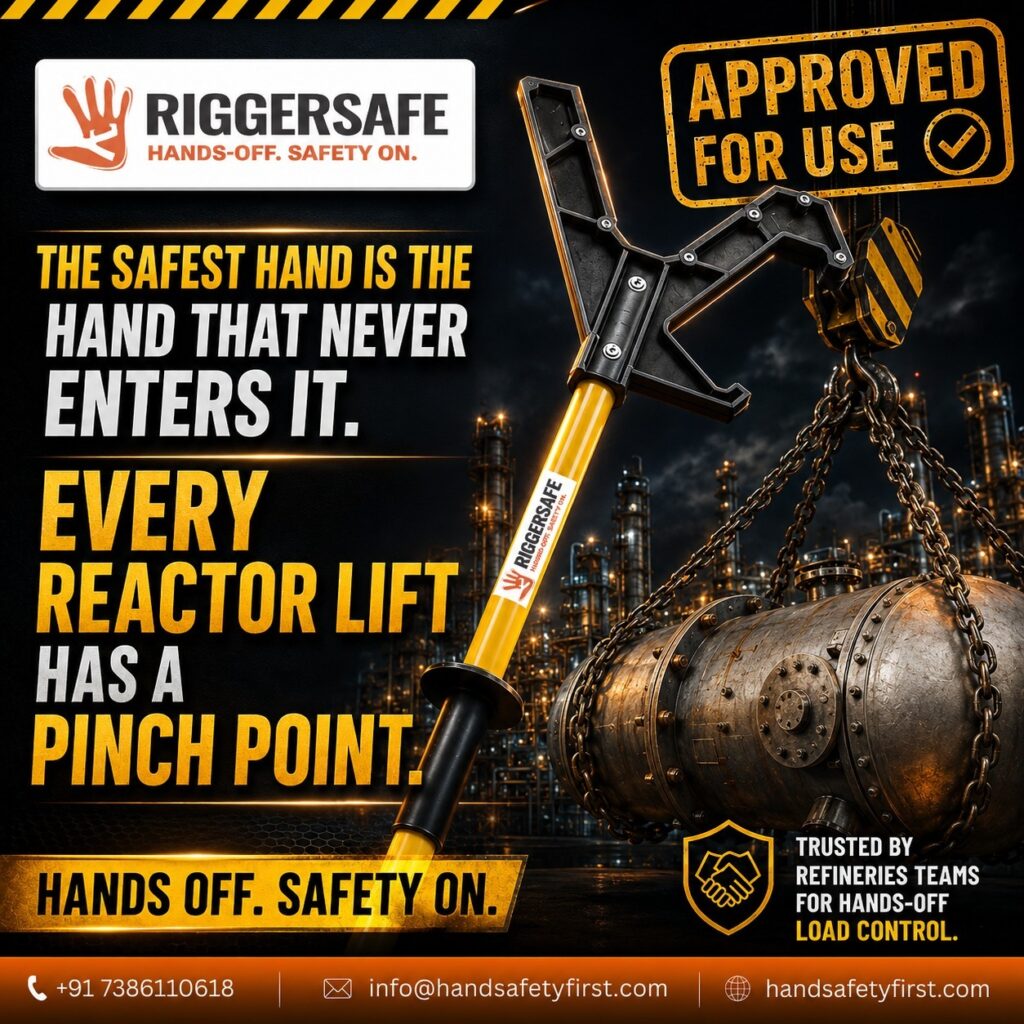
Every reactor lift has a pinch point. The safest hand is the hand that never enters the hazard zone.
What Are Reactor Lift Pinch Point Hazards?
Reactor lift pinch point hazards are crush and trapping hazards that occur when workers' hands enter spaces between a suspended reactor and surrounding structures during lifting, alignment, or positioning activities. These hazards are a leading cause of hand injuries in refinery and petrochemical lifting operations because exposure often increases during the final stages of load placement.
Introduction
Reactor lifting operations are among the most complex and high-consequence lifting activities performed in refineries, petrochemical facilities, and process plants.
Every lift is carefully planned. Rigging is inspected. Lift paths are reviewed. Crane capacities are verified. Yet hand injuries still occur.
The reason is often overlooked.
Most incidents do not occur while the reactor is travelling through open space. Instead, reactor lift pinch point hazards typically emerge during the final positioning phase when workers move closer to the suspended load to guide, align, stabilize, or inspect it.
As clearances reduce and precision requirements increase, hand exposure increases as well.
Understanding reactor lift pinch point hazards is essential for preventing injuries and improving refinery lifting safety.
Understanding Reactor Lift Pinch Point Hazards
A pinch point exists whenever a hand, finger, or body part can become trapped between a moving object and a fixed surface.
During reactor installation activities, reactor lift pinch point hazards commonly develop between:
- Reactors and foundations
- Reactors and support saddles
- Reactors and structural steel
- Reactors and adjacent piping
- Reactors and equipment frames
- Reactors and temporary supports
As the reactor approaches its final position, available clearance decreases and the severity of reactor lift pinch point hazards increases.
Why Reactor Lift Pinch Point Hazards Increase During Final Positioning
The final few inches of movement often create the highest level of risk.
At this stage, workers may need to:
- Verify orientation
- Check clearances
- Fine-tune alignment
- Correct rotation
- Position support points
Because these tasks require precision, workers are often tempted to move closer to the load.
This is exactly when reactor lift pinch point hazards become most dangerous.
Unexpected movement of even a few centimeters can create enough force to crush fingers or hands.
Why Reactor Lift Pinch Point Hazards Are Different From Other Lifting Risks
Reactors present unique lifting challenges.
- Large and cylindrical
- Extremely heavy
- Difficult to stabilize
- Installed in congested environments
- Supported by multiple rigging points
Unlike smaller loads, reactor lift pinch point hazards can develop around multiple sides of the load simultaneously.
Workers may avoid one pinch point while unknowingly entering another, making hand exposure difficult to recognize and control.
Common Situations That Create Reactor Lift Pinch Point Hazards
Manual Load Guidance
One of the most common causes of reactor lift pinch point hazards is direct hand contact with suspended loads.
Workers frequently attempt to push or guide the reactor manually during positioning.
Although intended to improve control, this practice places hands directly within potential crush zones.
Stabilizing A Swinging Reactor
Even minor load movement can encourage workers to reach toward the reactor.
If the load shifts unexpectedly, reactor lift pinch point hazards can immediately result in serious hand injuries.
Support Saddle Alignment
During installation, workers may attempt to align saddles or support points manually.
These areas often become severe reactor lift pinch point hazards because clearances continue to decrease as the reactor settles into position.
Clearance Inspections
Workers inspecting gaps and clearances often move close to the suspended load.
This can expose personnel to reactor lift pinch point hazards if hands enter confined spaces around the load.
Why PPE Cannot Eliminate Reactor Lift Pinch Point Hazards
Gloves remain an important component of industrial safety programs.
Training is important.
Procedures are important.
However, none of these controls remove reactor lift pinch point hazards because the hand remains near the load.
A glove may reduce cuts and abrasions, but it cannot protect against the crushing forces generated by a multi-ton reactor.
The most effective solution is reducing exposure itself.
Reducing Reactor Lift Pinch Point Hazards Through Hands-Off Load Control
Modern hand safety programs are increasingly focused on exposure reduction.
Rather than simply protecting the hand, organizations are working to keep the hand away from the hazard.
One of the most effective ways to reduce reactor lift pinch point hazards is through hands-off load control practices.
- Push loads from a safer distance
- Pull loads without entering pinch zones
- Guide positioning activities remotely
- Maintain control without direct hand contact
The farther the hand remains from the hazard zone, the lower the likelihood of injury.
Incorporating Reactor Lift Pinch Point Hazards Into Lift Planning
Many lift plans focus on:
- Crane capacity
- Rigging selection
- Ground conditions
- Load weight
- Travel paths
While these factors are essential, reactor lift pinch point hazards should also be identified before lifting begins.
Lift planning should include:
- Pinch point identification
- Alignment hazard assessment
- Worker interaction zones
- Final positioning risks
- Opportunities to eliminate direct hand contact
By addressing reactor lift pinch point hazards during planning, organizations can reduce exposure before work begins.
Why Hand Exposure Matters More Than Injury Statistics
Traditional safety metrics focus on incidents after they occur.
However, hand safety leaders increasingly focus on exposure.
Every time a hand enters a pinch zone, exposure exists.
Reducing reactor lift pinch point hazards requires identifying and eliminating those exposure opportunities before an injury occurs.
Building A Hands-Off Culture During Reactor Lifts
- Are workers touching suspended loads?
- Are hands entering pinch zones during alignment?
- Are workers manually positioning heavy equipment?
- Are safer alternatives available?
- Is hand exposure discussed during lift planning?
These questions help uncover hidden exposure points and improve lifting safety performance.
Frequently Asked Questions
What are reactor lift pinch point hazards?
Reactor lift pinch point hazards are crush and trapping hazards that occur when hands enter spaces between a suspended reactor and surrounding structures during lifting, positioning, or installation activities.
Why do hand injuries occur during reactor positioning?
Hand injuries commonly occur when workers attempt to guide, align, stabilize, or inspect a reactor while it is being positioned near structures, foundations, or support saddles.
How can reactor lift pinch point hazards be reduced?
They can be reduced by eliminating unnecessary hand contact, improving lift planning, identifying pinch zones, and using hands-off load control methods that allow workers to maintain distance from suspended loads.
Why are pinch points dangerous during suspended load operations?
Pinch points can generate crushing forces capable of causing severe hand injuries even when load movement is minimal.
What is hands-off load control?
Hands-off load control is a method of guiding, positioning, or controlling loads from a safer distance without placing hands directly near suspended loads or pinch points.
Conclusion
Every reactor lift has a pinch point.
The greatest risk often occurs during the final positioning phase when workers move closer to the load and hand exposure increases.
Understanding reactor lift pinch point hazards allows organizations to identify hidden risks before injuries occur.
By incorporating hand exposure into lift planning and adopting hands-off load control practices, refinery and petrochemical facilities can significantly reduce the likelihood of crush injuries during reactor installation and maintenance activities.
The safest hand is not necessarily the hand wearing the strongest glove.
Hand Safety First
Advanced Hand Safety Solutions
Hand Safety First helps organizations reduce hand exposure risks through practical hands-off load control solutions designed for real-world industrial operations.
Address:
Hand Safety First, India
Phone:
+91 73861 10618
Email:
info@handsafetyfirst.com
Websites:
handsafetyfirst.com
riggersafe.com