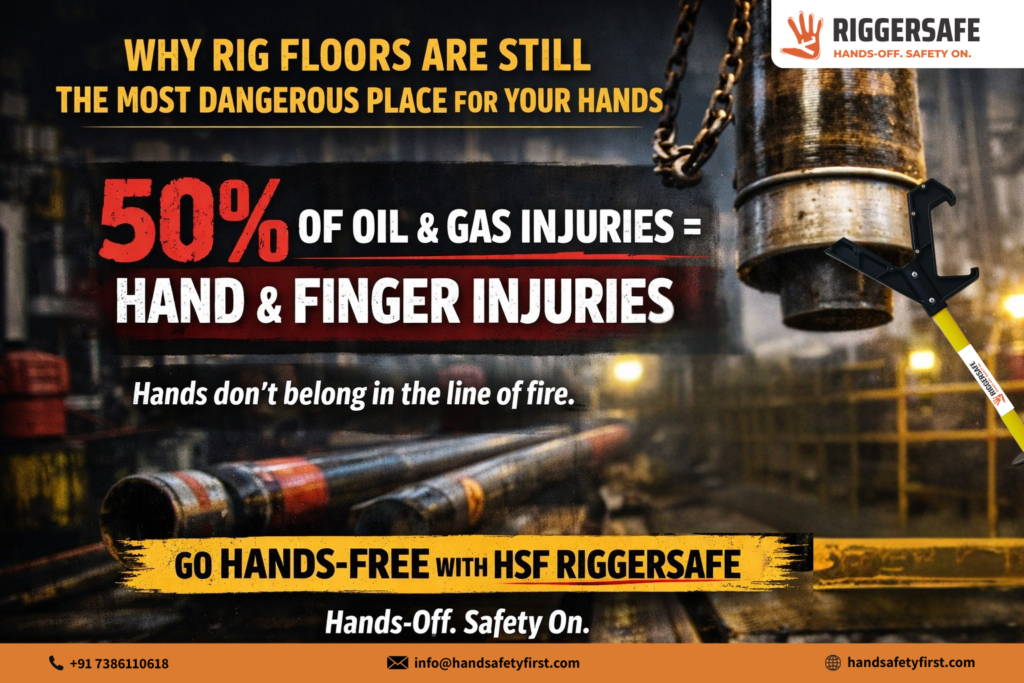
Every day, on rigs and platforms across the world, drillers and deck hands do something that looks routine but carries a quietly devastating injury record: they reach out and touch a moving, spinning, or suspended pipe with their bare hands.
It happens during tripping operations when a joint needs guiding to the rotary table. It happens on the catwalk when a drill collar is swinging off the V-door. It happens during casing runs, when a 13⅜″ joint needs threading home and someone’s hand is the tool being used to get it there.
At least 50% of all injury cases in the oil and gas industry involve hand and finger injuries — a figure documented by the Society of Petroleum Engineers. These are not freak accidents. They are the predictable outcome of workers placing their hands in zones that spinning chains, rotary tables, slips, and heavy suspended tubulars own by right.
The good news? A significant portion of these injuries are entirely preventable. The solution is not more glove specifications or more toolbox talks. It is an engineered, hands-free alternative to the most dangerous moments of pipe handling.
“At least 50% of injury cases in the oil and gas industry are hand and finger injuries. On the rig floor, the risk concentrates in transition moments — the seconds when a worker must physically guide steel.”
The Moment of Maximum Risk
The drill floor is not dangerous during normal drilling. The danger concentrates in transition moments — the seconds when a new joint is being introduced to the string, when a stand is being racked back, when a casing joint is being stabbed, or when fishing tools are being made up or broken out.
These are the moments when a worker must physically guide steel. The pipe is moving. The rotary table may be live. The tongs are swinging. The weight of a 30-metre stand of HWDP does not forgive a misplaced hand.
OSHA and IOGP incident data consistently identify rig floor pipe handling as the highest-frequency hand injury scenario in the entire upstream oil and gas sector. On the catwalk and pipe deck, the hazard shifts — bundles of drill pipe being separated, lifted, and moved by overhead crane, where hands get caught between tubulars, or between pipe and the physical structure of the rack.
Improvised methods — a piece of scrap rebar, a length of old drill pipe, a wooden dowel shoved under the load — are in active use on rigs every day. They are not solutions. They are hazards with handles.
What Hands-Free Pipe Handling Actually Looks Like
The HSF RiggerSafe Push/Pull Safety Tool was built specifically for this environment. On the rig floor, the tool’s U-shaped head accepts drill pipe from 2⅜″ to 6½″ OD, allowing the operator to push, pull, and guide a suspended joint with precision — at a safe distance from the rotary table, the slips, and the running tong.
On the catwalk, the same tool separates and guides individual tubulars from a pipe bundle without the operator’s hands ever entering the caught-between zone between pipe lengths.
During casing runs — one of the highest-risk rig floor tasks because of the weight, the OD, and the speed at which connections are made — the tool allows a second hand to guide the joint to the elevator without standing in the crush zone between the moving casing and the wellhead structure.
Available in 9 lengths (21″ to 96″), covering everything from confined deck operations to open rig floor setups. The fiberglass shaft provides non-conductive protection — critical in environments where e-line tools and electrical equipment are routinely present.
The Improvised Rod Problem
Ask any OIM or HSE manager what their deck crew uses to guide pipe when they don’t have a proper tool, and the answer is almost always the same: a length of old drill pipe, a pry bar, a piece of rebar, or whatever is on hand.
These improvised tools are often not logged, not inspected, and not controlled. When they fail — when they slip, when the load shifts, when the balance point is wrong — the consequence falls directly on the worker holding them.
The RiggerSafe Push/Pull Tool replaces this improvised practice with something engineered, inspectable, rated, and traceable. It can be registered in the rig’s tool inventory. It can be included in the pre-task safety check. It removes the improvised rod from the risk register entirely.
The Business Case Is Simple
A single hand injury on an offshore platform triggers a chain of consequences that no operator wants to manage: a RIDDOR or OSHA recordable incident, a STOP WORK event, a potential well control interruption, medical evacuation, investigation, and the reputational damage of an increased TRIR rate going into the next contract cycle.
The average cost of a lost-time hand injury in industrial settings exceeds $13,700 in direct medical costs alone, with indirect costs — lost production, investigation, replacement labour, and legal exposure — multiplying that figure many times over.
Against that background, the HSF RiggerSafe Push/Pull Tool is not an expense. It is the cheapest insurance policy on the rig floor.